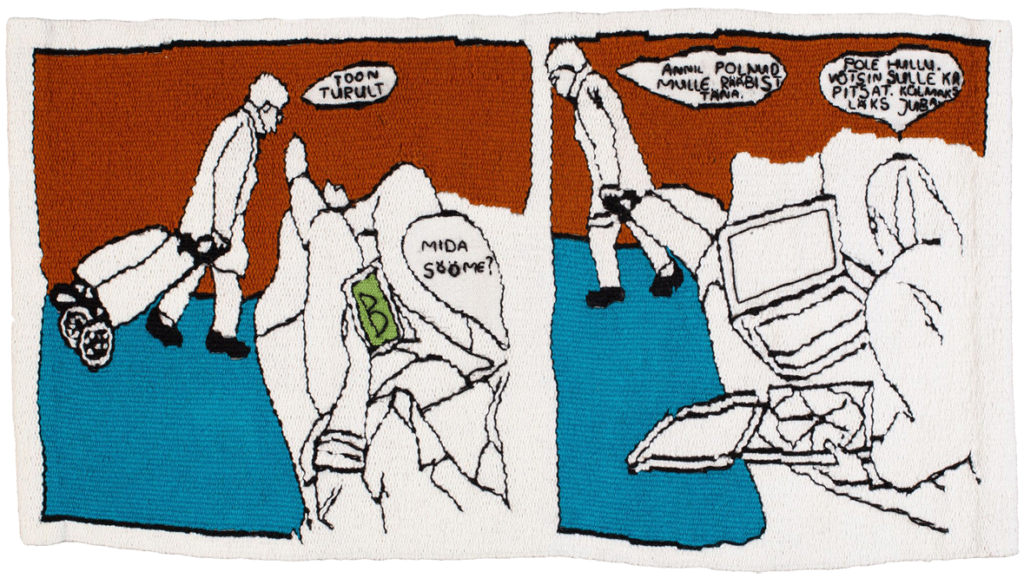
Inequality in the Smart Society on the Example of Generations
Tapestry, 2022
The rapid development of digital technology promises to make our lives easier, faster, and more connected. Yet behind this promise lies a contradiction: a society that becomes increasingly intelligent through technology does not necessarily become more inclusive.
This work explores the inequality that emerges between generations in a rapidly changing digital world.
For those who have grown up surrounded by digital devices, technology often feels natural and intuitive. For others, the constant need to adapt can become a source of uncertainty, frustration, and exclusion. Everyday activities that once required little effort increasingly demand new skills, new knowledge, and a willingness to navigate unfamiliar systems.
The tapestry presents this generational divide through a narrative composition, combining figurative imagery, dialogue, and elements of visual storytelling. Its almost comic-like language introduces humour and irony into a subject that carries serious social implications.
Rather than portraying one generation as superior to another, I am interested in the invisible boundaries created by technological progress. What happens when the ability to participate fully in society becomes dependent on one’s digital competence? And who is left behind when progress moves faster than people can adapt?
The choice of tapestry as a medium creates an additional layer of meaning. I use an ancient, slow, and labour-intensive technique to address a world increasingly defined by speed, automation, and instant communication.
Each thread requires attention, time, and physical involvement. In this way, the process of weaving becomes a quiet counterpoint to the technological acceleration depicted in the work.
I do not see technology itself as the enemy. My concern is the assumption that everyone can, or should, adapt to change at the same pace.
The work raises a question about the true meaning of progress: can we call a society advanced if some of its members are gradually losing their ability to participate in it?
Perhaps a genuinely smart society should be measured not only by the sophistication of its technology, but also by its capacity to remain human.